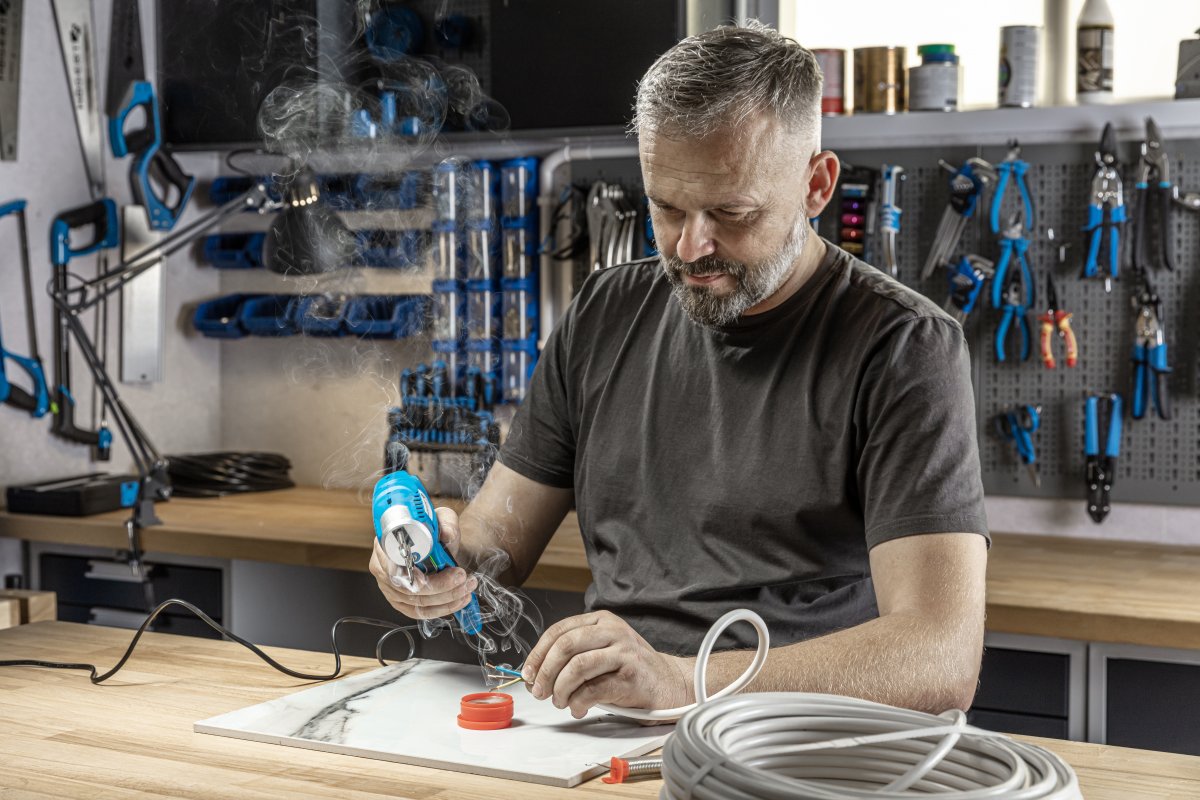
Which soldering iron for electronics, cables, repairs? Choosing a soldering iron!
A soldering iron is simple in construction yet a very functional tool useful both for professionals and for home use. However, the multitude of parameters and types of these devices can raise doubts when purchasing. Check, which soldering iron to buy, to make sure it performs best in your work!
How a soldering iron works? Prepare for soldering
A soldering iron is a device used to join components - most often metal ones. The material used for this purpose is solder. Commonly called tin, it is not made exclusively of that element – it contains about 40% lead and often other metals, e.g. silver or copper.Solder has a melting temperature lower than the temperature of the elements being joined. Thanks to this, after heating with a soldering iron it can permanently join them. Theseconnecting tools are most often used in electronics and electrical work, although some models will also work well for sheet metal work and various installation tasks.
Which soldering iron for home, and which for the workshop? Basic considerations
Before you decide which soldering iron to buy and which soldering accessories will be best, first determine what you will use the tool for. The primary issue is precision. Differentsoldering irons are intended for small electronic components (SMD), others for joining wires and repairing electrical circuits, and others – for copper pipes, gutters or roofing elements.Another matter is the power supply. In workshops and home garages, mains-powered soldering irons definitely perform better. However, if you work in the field, or the nature of the site does not allow connecting the device to power, consider mobile models such asa gas soldering iron or battery-powered ones.Other issues, e.g. what power soldering iron for electronics will be best, should be considered afterwards. First, however, take a look at the types of soldering tools available on the market.Which soldering iron to buy? Types of toolsLike other tools, e.g.voltage testers or electric screwdrivers, soldering irons are divided into those intended for professional use and universal tools that, with a bit of knowledge on how to use a soldering iron, can be successfully used at home. The point is to choose a soldering iron that best meets your needs.Heating-element soldering iron – intended for electricians and electronics technicians. A metal tip heated by an element allows precise soldering of small electronic components (SMD). Powered from the mains, a heating-element soldering iron usually does not have temperature control.Barrel soldering iron – a type of heating-element soldering iron in which the tip is made from a solid piece of metal. It is a very simply constructed tool, valued for its convenience and handy size. If you are wondering which soldering iron for cables and larger electronics components will work best, the answer is the barrel soldering iron. It also allows joining simple circuits and repairing household devices and beyond where wiring has failed. An advantage of this model is replaceable tips – a solution useful not only when you are unsure which tip for a soldering iron to choose, but also with frequent use and the need to replace this soldering accessory.Devices of various powers are available. For example, a30W barrel soldering iron has modest power. But you will also find models such as a 60W barrel soldering iron, and even a 100W barrel soldering iron.Transformer soldering iron – a versatile tool with a wide range of applications. Although purchasing this type of device is a bigger expense than a barrel soldering iron, it is an optimal choice for DIY enthusiasts. So if you are wondering which soldering iron for home will be best, choose a product such asa 100W transformer soldering iron. These types of soldering irons also work well for electrical work on cars.A transformer soldering iron is used for joining wires and repairing electrical circuits. To achieve high temperatures, this device uses a high-current flow. An integral part of this model is the transformer. If you are wondering which soldering iron to start with, transformer devices have a clear advantage. Their valued benefit includes, among other things, a short heating time. They are ideal for soldering thick cables and large surfaces. However, due to the relatively large weight of the device, prolonged use can be quite uncomfortable. A transformer soldering iron is also generally not suitable for work requiring high precision.Gas soldering iron – this model achieves a high tip temperature by heating with a propane-butane gas burner. A major advantage of the gas soldering iron is its mobility mentioned earlier. Due to its small size it will easily fit into atoolbox. Equipped with gas flow adjustment, a gas soldering iron will work well in typical workshop tasks, in precision joining, for plumbing and roofing work, but also e.g. for wood scorching or paint removal, similarly to agas torch.Battery-powered soldering iron – a variant of the heating-element soldering iron but powered by batteries. Due to lower power compared to other models, a battery-powered soldering iron is best suited for joining small components. Small, light and easy to transport, battery soldering irons are used in mobile work. However, it is worth remembering that they are somewhat less efficient than mains-powered devices and have shorter operating time.
What power soldering iron to choose?
Another issue when choosing a soldering iron is its power. Once you decide which soldering iron to choose, take into account the variety of device parameters.The answer to the question what power soldering iron for electronics, cables, etc. depends on the type of elements being joined. For small electronic parts, a lower-power device will do. It allows precise work and does not carry the risk of damaging delicate parts. A higher-power soldering iron heats up faster, so it is suitable for joining even large surfaces.Which soldering iron for cables will work best? Choose one with at least 100W. For soldering electronics you can successfully use 30W.
Point, chisel or pencil? Which soldering iron tip to choose?
Soldering accessories come with tips of various ends. As with power, consider the type of elements being soldered. Choosing the right tip affects comfort and precision of work.Which soldering iron tips are available? There are many options. You can choose a pencil-shaped tip, a point, a chisel, a flat tip, etc. The choice is usually quite intuitive – if you know what elements you plan to solder, you will select a tip suited to the comfort required for that kind of work. Tips differ by shape and size. Thinner ones are obviously best for electronics, thicker ones for cables and other larger surfaces.Keep in mind that thinner tips wear out faster. When considering which tip for a soldering iron to choose, also remember to match the soldering accessories to the model of device you own or plan to buy.
Which soldering iron for mobile work? Size
The size of the soldering iron matters – especially when work takes a long time, must be done in an awkward position, etc. For electronics and other small details it is certainly best to choose a lightweight device. A heavier soldering iron can be used successfully for joining larger elements.
Which soldering iron to choose – heating time
Tip heating time matters mainly in services where speed of work counts. Transformer soldering irons heat up the fastest – even in 7 seconds. However, when precisely joining e.g. integrated circuits, the heating time should not be too short. It may take even 2–3 minutes. In such work accuracy is important, and heating the soldering iron tip too quickly to too high a temperature could even damage the electronics.
Maximum operating temperature
For soldering devices the maximum operating temperature is related to the type of solder you intend to use. For hard solders it will be necessary to use a device with a temperature of at least 400°C. A lower temperature will suffice for soldering integrated circuits and other electronics. If you plan to use the soldering iron for various types of elements, a good solution is to buy a device with temperature control or choose two or more barrel soldering irons. In fact, these tools are not very expensive, and having several options gives greater accuracy of operation.
Soldering accessories – what you will need!
Once you decide which soldering iron to buy, think about additional equipment that may be needed. The basic and indispensable soldering accessory is of course solder. Others include fluxes, replacement tips, a desoldering pump, a stand for the iron, a sponge for cleaning tips, etc.If you decide to purchase a device in a practical case, such asa 200W transformer soldering iron, the necessary soldering accessories will be included in the set. This is very practical and convenient – you have all the elements in one place, and you can carry them safely in the case.
Which soldering iron to buy for home, and which for the workshop? Quality matters!
Regardless of whether you decide to buy a soldering iron for home use, you like DIY, or you need professional equipment for a service, opt fortools from a proven manufacturer. It is undeniable that the quality of the equipment used by a specialist directly affects the quality of their services. Precise and well-matched tools speed up the whole process and reduce the risk of errors caused by human factors.A high-quality soldering iron will last longer – whether you use it professionally or privately. It will also be safer than cheap tools from an unknown brand. A good soldering iron is an investment that will definitely pay off!
Car warning vest should be in every vehicle – in case of a breakdown it will allow the driver standing next to the vehicle to remain visible even after dark. However high-visibility vests are also an essential piece of equipment for construction workers, road workers and many other jobs. Check what to consider when buying a warning vest!
Is a warning vest mandatory?
A warning vest is an inexpensive item of clothing that everyone should have. It is useful not only in the car, but also when cycling after dark or even as protection for a pedestrian walking on the roadside.
Do you have to have a warning vest in the car? Polish regulations do not impose such a requirement on drivers. They indicate, among other things, the need to have a reflective triangle and a fire extinguisher. Although you won't get a fine for not having a warning vest, it is definitely worth having one. If you often travel with passengers, it's best to equip yourself with reflective vests in quantities sufficient to provide visibility to passengers if needed.
Reflective warning vest – a requirement in many professions
While a high-visibility vest for a motorcycle, bicycle or car is not required by regulations, in some professions it is. Professional high-visibility clothing is a necessary part of the wardrobe for airport workers, heavy equipment operators, construction workers, and people performing official duties on roads or in railway areas.
As for warning vests, regulations in 2023 require them to be one of three colors: yellow, orange or red. In addition to fluorescent colors, they must also have reflective elements.
High-visibility clothing is divided into class one, two and three. In the case of warning vests only classes one and two are possible, because class three requires reflectors on the sleeves or trouser legs. Such a standard is met, for example, by warning jackets.
A class one high-visibility vest must have 0.14 m2 of fluorescent background, while the total area of reflective elements must be 0.10 m2. For class two these values are 0.50 m2 and 0.13 m2 respectively. A professional class 2 vest is ORLA Warning Vest. Available in two colors – orange and yellow, it meets EU standards EN ISO 20471 and EN ISO 13688. Two reflective strips 5 cm wide provide visibility, and the anatomical fit guarantees comfort of use of the reflective warning vest both during work duties and while traveling by bike, motorcycle or on foot.
Summer and winter warning vest to suit your needs
When choosing a reflective warning vest for pedestrians, cyclists or motorcyclists, pay particular attention to its size and the quality of the material. Contrary to appearances, fit is very important – especially if you will be wearing the vest for a long time. This type of body-protecting clothing is available in standard sizes – from S to 3XL. Importantly, these products are not divided into men's and women's high-visibility vests – they are universal garments with a simple cut.
In cold months, an insulated work warning vest will provide protection against cold, wind and precipitation. The REMS insulated warning vest model has a warm inner layer. An additional convenience is a zipper closure instead of traditional Velcro. This solution allows better protection against low temperatures and weather conditions. The REMS warning vest also has two inner pockets that allow for storing accessories useful at work.
How much does a reflective warning vest cost?
Purchasing a reflective PPE vest will not usually ruin the household budget of someone who wants to be visible while cycling or to have such important protection in the car.
You can also find much cheaper products in stores and at online auctions. Do yellow and orange reflective vests for 4–5 PLN differ from those from a trusted manufacturer costing a dozen or so zlotys? Although they may look the same at first glance, you will notice the difference in how long the product lasts. The reflective warning material on high-quality vests is much more durable – it retains its shape after many wash cycles. Meanwhile, cheap reflective vests often lose their properties after just 2–3 washes.
So if you don't want to spend two years wearing a vest that has never been washed, choose a higher-class product. Quality matters especially when you buy reflective warning PPE vests for your employees.
Of course you'll pay more for an insulated warning vest with pockets. For the aforementioned REMS model you'll pay 166 PLN. In this case, however, you should particularly take quality into account. A vest of poor quality, made of non-breathable material, will cause significant discomfort during work. It is definitely better to opt for products from a trusted warning vest manufacturer.Author: Paweł Sokołowski
WHAT IS THE CE MARK?
The CE marking (Conformité Européenne) is the European conformity mark. Its use on a product's packaging indicates that the manufacturer has applied and fulfilled the relevant requirements contained in European directives/regulations, as well as in the European standards covering the product. A product that meets safety requirements will be marked with the CE mark, thereby informing the user that it is safe and has been properly placed on the market.WHY WAS IT INTRODUCED?
After the European Union removed trade barriers between Member States and established a common policy toward partner countries outside the EU, an area of free movement of goods was created within the Community. However, the main barrier to trade remained national requirements concerning, for example, the quality and safety of products. The national systems of regulations and standards used by countries often differed significantly from one another. This caused a range of problems for manufacturers who, in order to sell their product in different countries, had to meet separate requirements each time.
Because consumer safety could not be compromised by eliminating standards, the only solution was to harmonize national systems so that goods would be subject to the same requirements throughout the Community.
In 1993, European legal acts called NEW APPROACH DIRECTIVES were created at EU level. They defined essential safety requirements for different groups of products that must be met before they can be placed on the market or put into service on the Single European Market.
IS CE MARKING MANDATORY OR VOLUNTARY?
if a product falls under one of the New Approach Directives, CE marking is mandatory.
applying CE marking to products that are not subject to the New Approach Directives is prohibited.
WHO CAN AFFIX THE CE MARK?
CE marking may be affixed by the manufacturer or their authorized representative. Most products fall under Module A, i.e., the manufacturer's self-assessment module. If another module applies (B or D), an EU type-examination certificate must be obtained in cooperation with a notified body (a certifying institute).
WHAT IS A CE CERTIFICATE?
The term "CE certificate" does not exist in the nomenclature of the New Approach directives. If someone talks about a CE certificate, they most likely mean the EU declaration of conformity or the EU type-examination certificate confirming the product's conformity with the relevant EN standard.
Currently, the process of marking and certification is regulated by Regulation (EU) 2016/425 of the European Parliament and of the Council of 9 March 2016 on personal protective equipment and repealing Council Directive 89/686/EEC.
Source: https://www.oznakowanie-ce.plAuthor: Grzegorz Nowak
In 2022 as many as 66,606 occupational accidents were reported in Poland. 365 of the injured suffered very serious injuries, and the number of fatal accidents amounted to 180. In almost 80% the lower or upper limbs were injured. Among the most common causes was contact with a stationary or moving object. These data clearly indicate how important it is to provide employees with appropriate protective clothing.
Differences between protective clothing and workwear
To begin with, it is worth dispelling an important mistake. The term „occupational protective clothing (PPE)” and “workwear” are often used interchangeably. However, they do not mean the same thing. To fully answer this question, it is useful to know the exact definitions of both concepts.
Definition of workwear and protective clothing
Workwear is clothing used in the workplace when there is a high risk of soiling or damaging outer garments. In other words, workwear replaces the employee’s clothing in situations where it may become dirty or ruined while performing duties. The use of uniform work outfits may also be related to building brand recognition (e.g., bank or insurance company employees).
And what is protective clothing? The definition states that it is clothing used in the workplace that is intended to cover or replace personal clothing. In addition, it is designed to provide protection against hazards. Both conditions must be met, so workwear that does not protect against specific dangerous substances or events is not protective clothing.
Applications of workwear and protective clothing
When is protective clothing used? Examples of such situations can be found in every industry. It is most often used by employees on production floors and those working in the field, and its purpose is to protect against impacts and cuts (such as protective boots with a steel toe cap). There is also protective clothing for welding and heavy aprons for laboratory technicians who come into contact with hazardous substances.
Work clothes are used even more frequently. They can be found in organizations that care about brand recognition linked to employee attire. Work uniforms are also widely used in the catering industry.
Types of protective and work clothing
Any clothing can be divided according to the part of the wardrobe it represents: protective or work gloves, trousers, jackets, boots or vests. It is worth paying more attention to the classification of protective clothing depending on the hazard it is meant to protect against. In this context, one can list:
Protective clothing for welders, protecting against electric arc, burns and splatter.
Harnesses related to working at heights.
Insulating protective clothing, used by electricians.
High-visibility clothing, protecting road workers, as well as emergency services operating at the scene of a road accident.
Chemical protective clothing, resistant to short-term exposure to hazardous corrosive substances.
Protective earmuffs that protect against excessively loud equipment noise.
Flame-resistant protective clothing for firefighters and people working near open flames.
Additionally, categories of protective clothing may also concern seasons, such as winter and summer protective clothing.
Protective clothing markings
Types of protective clothing can also be characterized by the areas of the body they are meant to protect.
Protective clothing (symbol U).
Lower limb protection (symbol N).
Upper limb protection (symbol R).
Head protection (symbol G).
Face and eye protection (symbol T).
Hearing protection (symbol S).
Respiratory protection (symbol D).
Protection against falls from height (symbol W).
Full body insulating protection (symbol I).
So how to choose the appropriate protective and work clothing for your workplace? That is always the employer’s responsibility!
Employer's obligations regarding protective and work clothing
Under current labor regulations, the employer is obliged to provide the employee free of charge with workwear, protective clothing and personal protective equipment (PPE) if required by the working conditions. Importantly, the decisive factor is the conditions prevailing in a given work environment, not, for example, the job title. For this reason, employees in similar positions at different companies may receive a different set of clothing.
Protective clothing is the employer's obligation
The employer must determine what professional workwear and protective clothing are needed for each employee. This usually takes place during a dialogue with employees or their representative. These arrangements are then entered into the work regulations, which define the conditions for being in the workplace, as well as equipping employees with tools, materials, protective and work clothing and personal and hygiene protective equipment. Typically the details are presented as a protective clothing allocation table for each position.
Work clothing and footwear provided by the employer
Work and protective clothing are provided free of charge. At the same time, they remain the property of the employer. This means that upon termination of employment, all personal protective equipment and allocated clothing must be returned to the supervisor. Also, in the event of clothing being destroyed due to the employee’s fault, reimbursement of the purchase costs is required (after accounting for depreciation).
Employer's duties regarding employee safety
The employer’s duties related to protective clothing and workwear also include cleaning, maintenance, repair, dust removal and disinfection. However, employees often wash their work clothes themselves. In such cases they are entitled to reimbursement of the costs they incur.
Standards and certifications of workwear and protective clothing
Workwear does not require certification, because its primary task is to protect personal clothing from dirt or damage. However, specialist protective clothing for workers must meet specific standards and criteria in order to effectively protect against hazards in the workplace.
Clothing materials: what determines their protective properties?
Protective garments are made from natural materials (cotton), regenerated (cellulose-based) and synthetic materials (polyester or polyamide). From these, several dozen popular materials with specific properties have been developed. Among them you can find:
Ortalion made from polyester. It is characterized by very low weight and high resistance to damage.
Fleece, a soft and warm polyester knit.
Stretch, i.e. stretch fabrics with added Lycra or PBT.
Corduroy, a warm cotton fabric resistant to cuts and tears, but prone to abrasion.
Ballistic nylon, also used in the production of bulletproof vests. It is very resistant to damage and abrasion.
Kevlar, an elastic material that is also extremely durable.
The choice of the appropriate material depends on the work environment and the conducted occupational risk analysis.
Certification by EN ISO standards: what does it mean for protective clothing?
In Poland, EU Regulation No. 2016/425 of 16 March currently applies. It specifies a number of standards for particular types of protective and specialized clothing. It is there that the exact parameters that protective clothing for firefighters, welders and other positions must meet are defined.
All protective garments must also have certificates confirming compliance with the above standards. To obtain them, clothing undergoes rigorous laboratory tests, which must then be repeated at regular intervals.
Summary: protective and work clothing
There are still many workplace accidents in Poland. To provide employees with the best possible protection, protective clothing and personal protective equipment are used in accordance with the protective clothing allocation table. Each such garment must meet protective clothing standards, confirming protection against hazards in the working environment.
In many positions, an employee also receives workwear that protects personal clothing from damage or soiling. In this case, there is no need to obtain certifications.
Both workwear and protective clothing belong to the employer, who should care for them: clean, repair and maintain them.Author: Grzegorz Nowak